
The silent failure of a single corroded tendon can trigger a $12M retrofit—here’s how to stop it before it starts.
1 The Invisible Clock: Understanding Post-Tension Slab Lifespan
Post-tension (PT) slabs revolutionized modern construction by enabling thinner floors, longer spans, and reduced material use. Yet their lifespan—typically 50-75 years—faces relentless attacks from forces engineers call “the silent killers”:
- Prestress Loss Dynamics: Over decades, slabs lose 15-25% of initial prestress through anchor seating slip (3-7% loss), concrete creep (10-15%), and shrinkage (5-8%). This gradual disarmament leaves slabs vulnerable to deflection and cracking under loads they once easily resisted.
- Corrosion’s Stealth Campaign: Grout voids as small as 1 cm³ create moisture traps. When chlorides invade (e.g., from deicing salts or marine environments), they initiate electrochemical reactions that eat steel at 0.1-1 mm/year7. The 2018 Florida International University bridge collapse tragically demonstrated how unbonded sections with damaged HDPE sheaths accelerate this process.
- Material Aging: Cementitious grout carbonation lowers pH from 12.5 to <9, dissolving the protective oxide layer on strands. Meanwhile, freeze-thaw cycles in cold climates expand trapped water by 9%, fracturing grout and concrete.
The Critical Window: Years 20-35 mark the corrosion tipping point where tendon cross-section loss exceeds 15%, risking sudden rupture under peak loads. Proactive monitoring before Year 20 is non-negotiable.
2 Why Cracks Appear: Decoding the Five Failure Pathways
2.1 Hydraulic Sabotage: Freeze-Thaw Expansion
Water intrusion into PT ducts turns destructive below 0°C. As it freezes, crystallization pressure (exceeding 200 MPa) bursts ducts and concrete. The telltale sign? Linear cracks along tendon trajectories—common in bridge decks and parking garages in cold regions.
Engineering Defense: Specify non-porous HDPE ducts with sealed joints instead of corrugated metal. For existing structures, vacuum-assisted grouting achieves 98% void elimination versus 70-85% with conventional methods.
2.2 Anchor Zone Stress Magnification
The concentrated bearing stress behind anchors can spike to 2-3 times the average slab stress. If unreinforced, this triggers radial bursting cracks fanning out at 30-45° angles.
Prevention Toolkit:
- Spiral reinforcement in end blocks (ACI 318 §25.7)
- Steel bearing plates distributing loads
- Staged stressing to limit stress peaks
2.3 Grouting Defects: The Corrosion Catalyst
Poor grout fluidity leads to bleed water pockets (top) and sedimentation voids (bottom). These become corrosion cells where chloride-induced pitting reduces tendon diameter unevenly. Alarmingly, voids >150 mm accelerate corrosion rates by 400%.
Grout Quality Non-Negotiables:
| Parameter | Target Value | Test Standard |
|---|---|---|
| W/C Ratio | ≤0.40 | ASTM C939 |
| Bleed | <2% at 3hr | ASTM C940 |
| Fluidity | 25-35 sec flow | EN 445 |
2.4 Overload Cracks: When Design Limits Are Breached
Post-tensioned slabs crack under excessive live loads (e.g., unauthorized heavy equipment) or differential settlement. Unlike shrinkage cracks, these appear as wide (>0.3 mm), propagating fractures often aligned with maximum moment zones—midspans or near supports3.
2.5 The Shrinkage-Temperature Tug of War
Early thermal shrinkage fights against prestress compression. If concrete tensile strength (≈2-4 MPa) loses this battle, map cracking emerges. Worse, daily thermal cycles in roofs or parking decks cause fatigue damage at crack tips, slowly widening them.
3 Advanced Repair Protocols: Beyond Patching
3.1 Active Reinforcement: Restoring Lost Prestress
For slabs with >20% prestress loss:
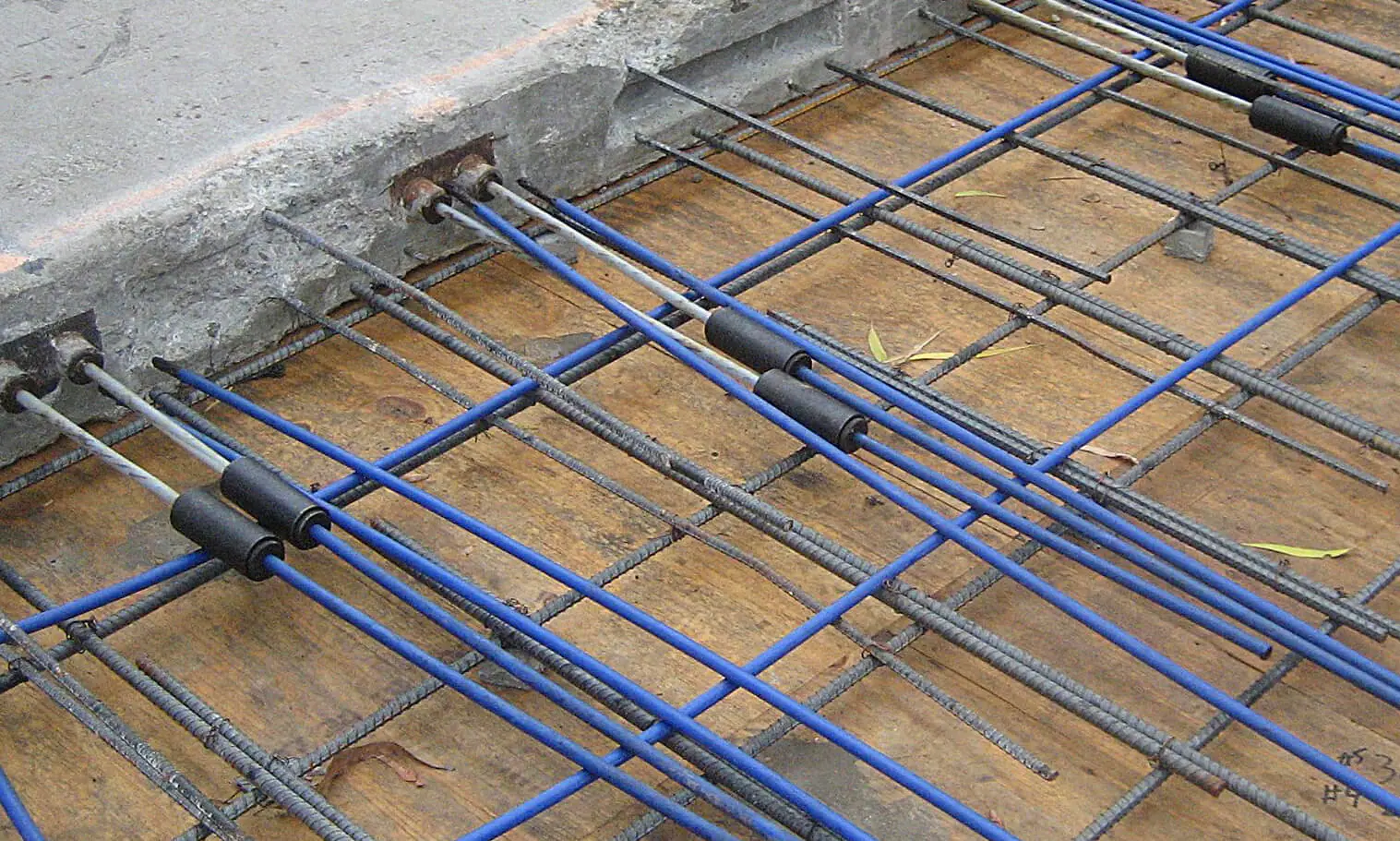
- External PT Strands: CFRP tendons (e.g., Leadline®) installed in U-shaped profiles outside the slab. Advantages: corrosion immunity and 70% weight savings versus steel.
- Carbon Fiber Laminate Bonding: 1.2 mm thick CFRP sheets epoxy-bonded to tension zones add flexural capacity without weight penalty.
3.2 Corrosion Mitigation in Voids
Void remediation workflow:
- Locate voids via ground-penetrating radar (GPR) or impact-echo testing
- Drill injection ports at 1.5 m spacing
- Inject polyurethane resin (expansion ratio 1:10) to displace water and seal ducts
- Follow with corrosion inhibitor (e.g., calcium nitrite) to passivate steel
3.3 Structural Crack Repair
- <0.2 mm cracks: Low-viscosity epoxy injection (e.g., Sikadur® 52)
- >0.2 mm cracks: Urea-formaldehyde foam for flexibility
- Spalled concrete: Remove damaged areas, apply cathodic protection anodes, repair with shrinkage-compensating concrete
4 Case Studies: Lessons from the Field
4.1 The San Francisco Garage Collapse (2012)
Failure chain: HDPE sheath damage during installation → Water ingress → Unbonded tendon corrosion → Sudden rupture of 7 tendons → Partial collapse
Repair cost: $120 million
Key lesson: Mandatory sheath inspection using borescopes before grouting now standard in PTI protocols.
4.2 Canadian Highway Bridge End Blowout (2006)
Problem: Radial cracks from anchor zones due to insufficient spiral reinforcement
Fix: Installed external ring tendons applying 150-tonne compression force around anchors
Outcome: Crack movement halted within 48 hours of stressing
5 Proactive Defense: Monitoring and Maintenance Innovations
5.1 The Digital Sentinel System
Modern PT slabs embed IoT-enabled sensors for real-time tendon health assessment:
- FBG (Fiber Bragg Grating) strain gauges: Detect force loss >3%
- Wireless corrosion sensors: Alert at pH <10.5 or [Cl⁻]>500 ppm
- AI analytics platforms: Predict remaining lifespan using crack propagation algorithms based on Paris’ law: da/dN = C(\Delta K)^mWhere da/dN = crack growth per cycle, ΔK = stress intensity range
5.2 Life-Extension Design Upgrades
- Tendons: Replace steel with CFRP strands (service life >100 years)
- Grout: Microsilica-modified mixes with 0.5% superplasticizer
- Ducts: Double-layer HDPE with RFID tags for location mapping
Conclusion: Building Slabs That Outlive Their Designers
Post-tension slab failures aren’t random—they follow predictable pathways starting with grout voids, corrosion triggers, or stress miscalculations. The repair revolution has moved from reactive patching to AI-driven predictive maintenance and self-monitoring structures.
Three Transformative Shifts:
- From visual inspection to sensor networks: Embedding diagnostics during construction costs <0.5% of retrofit.
- From steel to composites: CFRP tendons eliminate corrosion’s $23B/year global damage bill.
- From manual to automated stressing: Computer-controlled jacks limit human error in force application.
Crack Type Causes Repair Solutions Prevention Strategies Longitudinal Cracks Freeze-thaw expansion in ducts Polyurethane void filling + inhibitor injection Non-porous HDPE ducts Radial Cracks Anchor zone stress concentration External CFRP wrapping + ring tendons Spiral reinforcement Map Cracking Thermal-shrinkage conflict Epoxy injection + surface sealing Controlled curing + shrinkage-compensating concrete (The techniques described have stabilized structures from Toronto to Tokyo—implement them before the cracks implement their own agenda.)


