
1. Introduction: The Concrete Revolution
Concrete dominates modern construction but harbors a critical flaw: exceptional compressive strength paired with dismal tensile resistance. This weakness causes cracks under load, shortening structural lifespans. Enter prestressing – the game-changing technique of pre-compressing concrete to counteract service loads. By permanently embedding internal compression forces, engineers create structures that defy conventional limits: longer spans, thinner sections, and crack-free performance. Two distinct pathways achieve this:
- Pre-Tensioning (PreT): Steel tensioned before concrete placement
- Post-Tensioning (PT): Steel tensioned after concrete hardening
Understanding their nuances unlocks next-level structural design.
2. Pre-Tensioning: Factory Precision
How It Works
Tendons are stretched between massive abutments (75-80% ultimate tensile strength). Concrete is cast around them. Once hardened (~35 MPa strength), tendons are released – transferring stress to concrete via bond mechanism.
Critical Process Steps:
- Tendon anchoring in casting beds
- Hydraulic jacking (force monitored by load cells)
- Concrete pouring and steam curing
- Controlled tendon release (thermal cutting or gradual hydraulic release)
Dominant Applications:
- 🏭 Precast hollow-core slabs (30% faster installation)
- 🛤️ Railway sleepers (e.g., UK HS2 project: 2.5 million units)
- ⚡ Concrete poles (60m spans without sagging)
Advantages:
- ✅ 40% lower production cost vs. PT (no anchors/grouting)
- ✅ Superior quality control in factory environments
- ✅ Minimal long-term maintenance
Limitations:
- ❌ Max span: 40m (practical limit for transportable elements)
- ❌ Inflexible tendon profiles (linear only)
- ❌ End-zone cracking risk during destressing
3. Post-Tensioning: On-Site Flexibility
Core Principle:
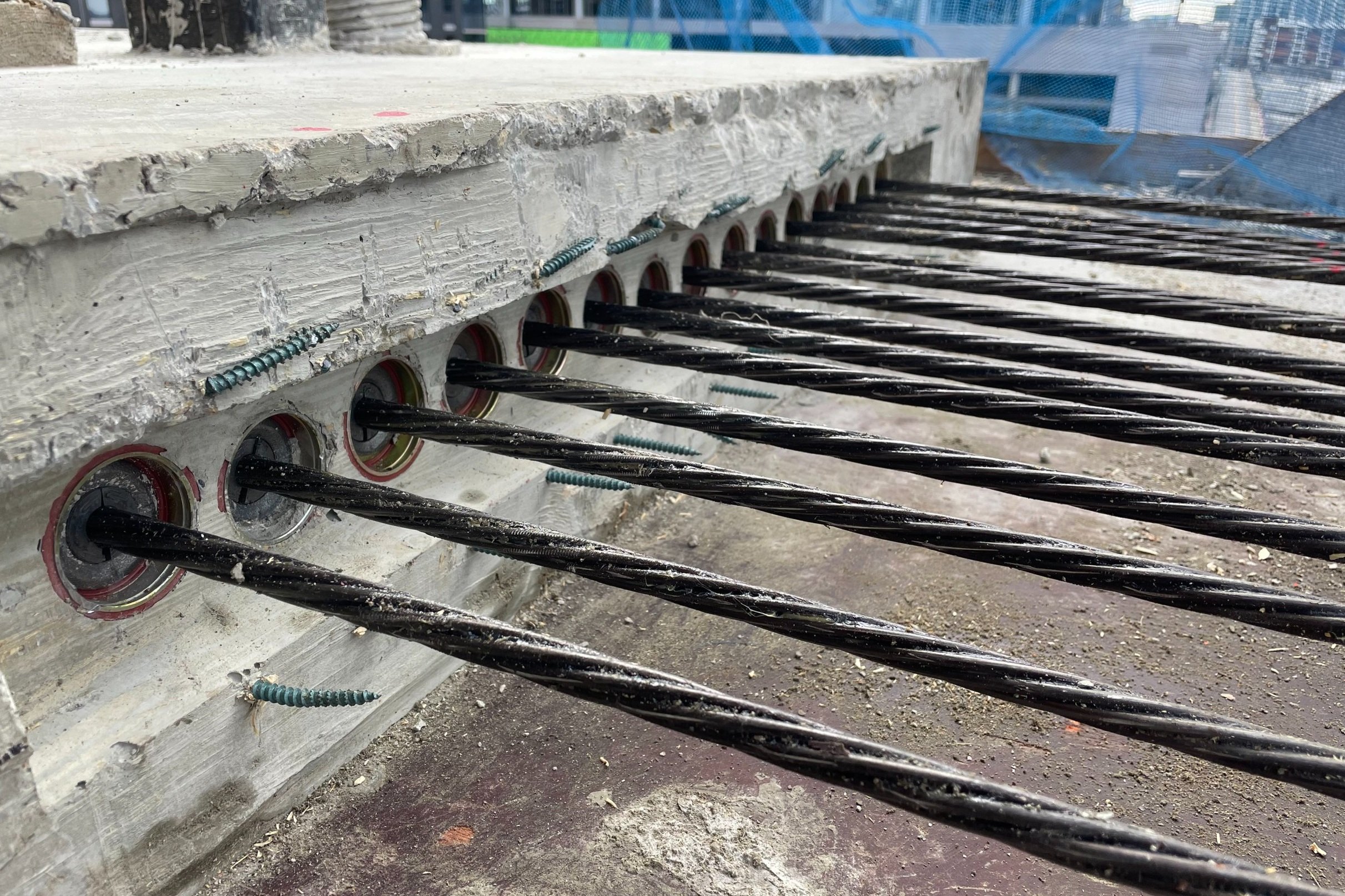
Concrete is cast with embedded ducts. After curing, tendons are threaded, tensioned against hardened concrete, and locked with anchors. Grout injection provides corrosion protection.
Types of PT Systems:
| System Type | Mechanism | Best For |
|---|---|---|
| Bonded PT | Grout-filled ducts; full composite action | Bridges, nuclear containments |
| Unbonded PT | Grease-coated strands in HDPE sheaths | Parking decks, slabs |
| External PT | Tendons outside concrete section | Seismic retrofits |
| Segmental PT | Ducts aligned in precast segments | Cable-stayed bridge decks |
Essential Tools & Equipment:
- Hydraulic Stressing Jacks:
- Capacity: 150–400 tons
- Precision: Dual-control systems (pressure + elongation) with ±3% accuracy
- Brands: VSL SC-1030, DYWIDAG ETS 1500
- Grout Equipment:
- Colloidal mixers (1,500 rpm shear for void-free grout)
- Vacuum-assisted pumps (0.5–0.7 MPa injection pressure)
- Digital Monitoring:
- Wireless load cells (e.g., StrainSense PT-Monitor)
- BIM-integrated force tracking (AutoCAD/Revit plugins)
Critical Process Risks:
- ⚠️ Grout voids → Corrosion (Florida’s Niles Channel Bridge collapse)
- ⚠️ Anchor slippage (requires 150% proof-load testing)
- ⚠️ Friction losses in curved tendons (up to 25% force loss)
4. Head-to-Head Comparison: Which is Better?
| Parameter | Pre-Tensioning | Post-Tensioning | Engineering Verdict |
|---|---|---|---|
| Cost | $18–25/m² | $35–50/m² | PreT wins for budget projects |
| Span Capability | ≤40m | ≥150m (e.g., Rio–Antirrio Bridge) | PT dominates megastructures |
| Construction Speed | 5 days/cycle (factory) | 14–21 days/slab (site) | PreT 3x faster |
| Seismic Performance | Brittle failure risk | Energy dissipation via tendon yielding | PT superior in seismic zones |
| Maintenance | Low (fully encapsulated steel) | High (grout defect inspection) | PreT lowers lifecycle cost |
Decision Matrix:
- ✅ Choose PreT when: Mass-producing standard elements (slabs/beams), budget-driven, tight quality control needed.
- ✅ Choose PT when: Designing complex geometries (curved bridges), retrofitting, or pushing span limits beyond 50m.
5. Innovation Frontiers
Materials Revolution:
- CFRP Tendons: Carbon-fiber-reinforced polymers (e.g., Leadline®) – 70% lighter, corrosion-immune
- Shape Memory Alloys: Nitinol wires that “self-tension” when heated (University of Michigan trials)
Digital Transformation:
- AI Grout Void Detection: Ultrasound tomography + machine learning (98% accuracy vs. 70% manual)
- Digital Twins: Live monitoring of tendon forces (e.g., Singapore’s Marina Bay Suites PT slabs)
Sustainability Impact:
- ♻️ 30% less concrete vs. RC structures → 8,000 tons CO₂ saved in a mid-rise tower
- 📉 100-year design life → 60% lower lifecycle emissions
6. Landmark Case Studies
PreT Success:
- Hong Kong International Airport Runway: 120,000 PreT slabs installed in 18 months. Zero cracking after 10+ years.
PT Engineering Marvel:
- Burj Khalifa (Dubai): 45,000 m³ PT mat foundation withstands 600,000-ton vertical load.
- Millau Viaduct (France): Segmental PT deck spans 2.5km across valleys.
PT Failure Lesson:
- San Francisco International Airport Garage: Unbonded tendon corrosion → $120 million repair. Root cause: HDPE sheath damage during installation.
7. Conclusion: The Future is Prestressed
Pre-tensioning delivers unbeatable efficiency for standardized elements, while post-tensioning enables architectural marvels once deemed impossible. As robotics automate stressing operations and smart sensors eradicate grouting defects, one truth remains:
“Prestressing isn’t just about strength—it’s about redefining the possible. Choose PreT for economics; embrace PT for impossibility.”
Resources for Practitioners:
- 📚 Design Guides: PTI Manual (Post-Tensioning Institute), FIB Bulletin 65
- 🧮 Software: ADAPT-Builder (PT slab design), MIDAS Civil (bridge PT)
- 📜 Codes: ACI 318-19 (Ch. 20), EN 1992-1-1 (Sec. 8.10)


